

News
Tribute to Patricio Guzmán
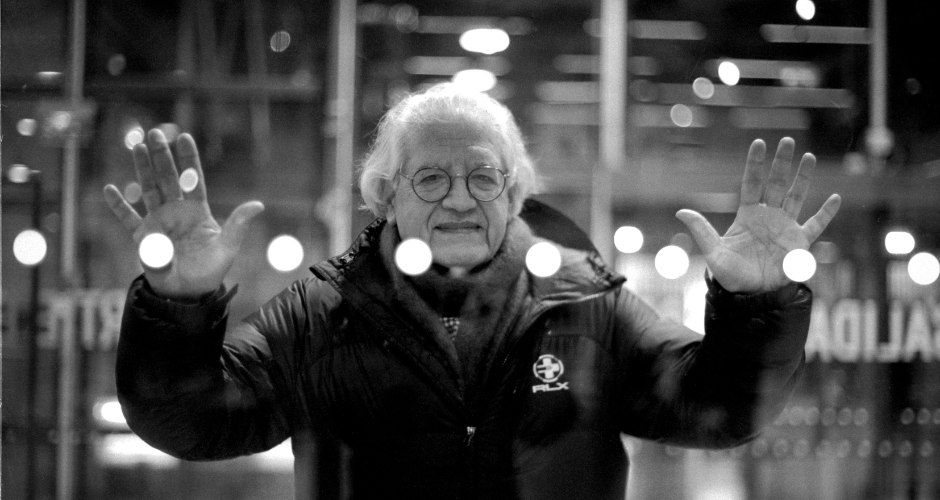
The members of Ateliers Varan were deeply saddened to learn of the passing of Chilean filmmaker Patricio Guzmán. His films have left an indelible mark on both the history of his country and the history of documentary cinema. The members of the association extend their deepest condolences and sympathy to his family and loved ones.
Yves de Peretti, a filmmaker and member of Ateliers Varan, pays tribute to him in this text.
For Patricio Guzmán
Indeed, the year 2026 has been a tragic one for documentary cinema: after the patriarch Wiseman and the poet Dieutre, another prominent figure has now passed away. His body has left us, but his films and his ideas will continue to nourish our thinking for a long time to come. He was rightly so proud of the film that nearly cost him his life in 1973 (just as it claimed the life of his cinematographer Jorge Müller, who “disappeared” in 1974) and which made him famous around the world: The Battle of Chile. This epic portrayal, with the power of direct cinema, chronicled the final two years of that rare experiment in democratic revolution: Salvador Allende’s Popular Unity (1970–1973). Patricio was “the right person at the right time”—a fact that did not escape Chris Marker, who was then traveling the world to film the revolution in progress. He knocked on Patricio’s door in Santiago to offer him the chance to screen The First Year in Paris—the film Patricio had shot with whatever resources he had at his disposal, shortly after returning to Chile with his degree from the film school in Madrid. Shortly thereafter, by reaching out to his wealthy left-wing friends, Marker arranged for 110 boxes of 120-meter film and an equal amount of magnetic tape to be sent directly from Rochester—Kodak’s headquarters—so that Patricio could continue chronicling this global event. Chris Marker’s influence looms large over Patricio’s work, which is entirely devoted to building an archipelago of memory around the trauma that September 11, 1973, represented for the world.
Twenty years later, I crossed paths with Patricio in Marseille when he received the Grand Prize at the “Vue sur les Docs” competition—the predecessor to the FID—for his film La Croix du sud, a hybrid, partly fictionalized work in which he recounted four centuries of the history of the Catholic Church in Latin America. At the festival’s closing night, where I had screened a short film, he marveled at the lightness and grace that could emanate from direct cinema, even as he himself had ventured into a highly restrictive form.
The evolution of his films clearly embodies the evolution of documentary cinema, from the militant undertaking of the early 1970s to the increasingly elegiac films in which he combined his personal history and that of his country with poetic lyricism. I remember our astonishment when, at his home with a few close friends—including Catalina Villar and editor Claudio Martinez—we discovered Nostalgia for the Light, that cinematic universe that no one had wanted to produce, prompting his wife and collaborator Renate Sachse to start a production company, and which he would go on to present a few weeks later at the Cannes Film Festival. He watched our reactions closely and was amused by our wonder at seeing that he had managed to completely reinvent his cinema without losing sight of that traumatic history that Chile wanted to forget but to which he remained stubbornly faithful. By recalling his childhood and his love of Jules Verne, he had managed to pierce a double opacity—that of space and that of time.
I also remember, a few years earlier, the motionless faces of the dictatorship’s victims staring fixedly at the camera at the end of Cas Pinochet, bearing witness to the unspeakable through their silence. He made this silent, unyielding directness a recurring motif in several of his films—one of the formal elements with which he methodically constructed his cinematic language. Adiós, Patricio; we will continue to “work on the present and wage the battle for memory,” as your compatriot Carmen Castillo so beautifully put it upon the announcement of your passing.
– Yves de Peretti
© Photo of Patricio Guzmán by Stefano Missio
Ask Us
Questions about our training courses? Please contact us 01 43 56 64 04
6, impasse de Mont Louis
75011 Paris